
Camino Le Puy (Via Podiensis / GR65): 10 Things to Know Before You Go

Walking the Camino from Le Puy-en-Velay? Here are ten things worth knowing before you lace up your boots.

There's something wonderfully exciting about preparing for your first Via Podiensis.
Perhaps you've been looking at photographs of the Aubrac plateau, reading about the medieval villages along the GR65, or imagining that first morning when you step out of Le Puy-en-Velay with your backpack and the open road ahead.
You've probably researched the distances, studied a few maps, and wondered whether you're fit enough for the hills.
But after walking the Via Podiensis several times, we've come to realise that some of the most useful things to know have very little to do with kilometres.
They're the little practicalities, surprises and peculiarities of walking across rural France that can make all the difference.
So, here are ten things we'd love you to know before you set off.
1. The Via Podiensis doesn't believe in gentle introductions
If you're hoping to ease yourself gradually into the walking, the first few days may come as a surprise!
The route out of Le Puy-en-Velay takes you into the hills of the Velay, and before long you'll be negotiating the steep descents and climbs of the Allier Gorge.
It's beautiful country, but your legs will certainly know they've been walking.
The temptation, particularly when you're feeling fresh and enthusiastic, is to cover as much ground as possible.
Resist it.
Give yourself time to find your rhythm. Take breaks, enjoy the scenery, and don't feel obliged to keep up with someone who's walking faster than you.
In fact, if there's one single piece of advice we could give anyone setting off on the Via Podiensis, it would be this: PACE YOURSELF!
It's so easy to get carried away by the excitement of those first few days, especially when you're feeling strong and full of enthusiasm. But walking the Camino isn't about how far or how fast you can go. It's about finding a pace that feels comfortable, listening to your body, and remembering that you need to get up and do it all again tomorrow!
Start gently, build up gradually, and leave yourself enough energy to enjoy the journey.
You've got a long way to go. There's absolutely no hurry.
2. France has a rather particular relationship with opening hours
Picture this.
You've been walking for several hours. The sun is shining, your stomach is rumbling, and you're dreaming of a delicious coffee and a freshly baked croissant.
You arrive in the next village.
Everything is closed.
Welcome to rural France!
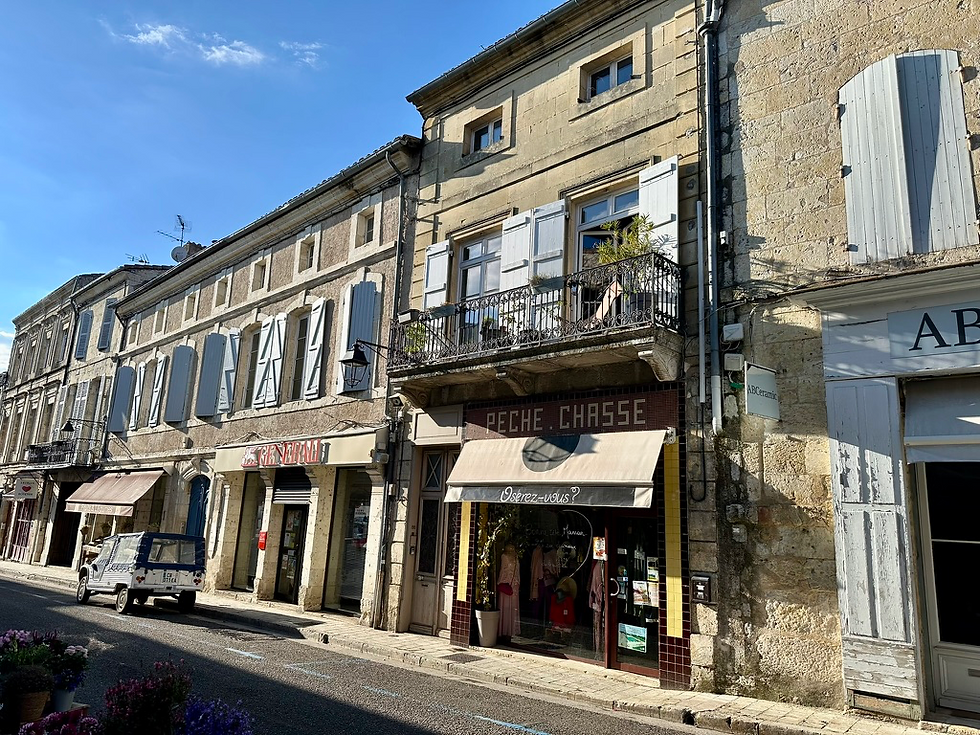
Shops may close for two or three hours at lunchtime. Sundays can be particularly quiet, and Mondays aren't always much better. In smaller villages, some businesses operate on very limited schedules.
And that lovely little café you spotted on Google Maps? It might not be open when you arrive.
The solution is simple: always carry a little something to eat, keep your water topped up, and check what's available before setting off.
We've written a whole article about this very subject, Opening Hours in France, which is well worth reading before your Camino.
3. Dinner is about much more than food
One of the loveliest traditions of the Via Podiensis is the communal evening meal.
Many gîtes offer demi-pension — dinner, a bed and breakfast — and the evening meal is often served around a large table.
You'll find yourself sitting beside people you've never met, sharing bread, passing dishes and listening to stories from all sorts of different lives.
Of course, the conversation is often in French.
Don't let that put you off.
Nobody expects you to deliver a speech in perfect French. A few simple expressions, a smile and a little curiosity will go a long way.
And there's something rather wonderful about the way a table full of strangers can become a little community by the end of the evening.

4. The Aubrac plateau is beautiful. It also has a mind of its own.
Ah, the Aubrac!
Those enormous open skies, rolling grasslands, ancient stone walls and beautiful Aubrac cattle grazing peacefully in the fields.
It's one of the most memorable landscapes of the entire route.
But there's something you should know.
The weather can change remarkably quickly.
A glorious sunny morning can turn into an afternoon of wind, mist and driving rain. And because the plateau is so exposed, it can feel surprisingly cold, even in the warmer months.
So don't be tempted to leave your rain gear behind just because the forecast looks promising.
And when the sun does shine, take your time.
Some landscapes deserve to be walked through slowly.

5. The Camino from Le Puy: Walk it your way!
This is something we feel quite strongly about.
Many guidebooks divide the Via Podiensis into a series of daily stages, each with its own starting and finishing point.
They're useful suggestions, of course.
But they're not rules.
You might feel wonderful one morning and decide to walk a little farther. On another day, perhaps you'll discover a village you'd love to explore, meet someone interesting, or simply feel like stopping early.
Why shouldn't you?
The Camino isn't a race, and there's no prize for arriving first.
Naturally, accommodation availability and distances between villages will sometimes influence your choices. A little forward planning is sensible.
But you don't need to organise every moment of your journey before you've even taken your first step.
Plan as much — or as little — as you like.
That's the philosophy behind Rob's guide, Walking the Via Podiensis Made Simple.
It gives you the maps, distances, elevation profiles and accommodation information you need to create your own stages, rather than telling you where you ought to stop each night.
Because sometimes the best part of a Camino is having the freedom to change your mind.
6. There will probably be a day when you wonder what on earth you're doing
Let's not pretend that every day on the Camino is wonderful.
Sometimes it rains all day. Sometimes your feet hurt. Sometimes you're tired, hungry, irritated, or thoroughly fed up.
You might have a miserable night's sleep, discover that your carefully chosen accommodation isn't quite what you expected, or find yourself climbing yet another hill when you were absolutely certain the climbing was over.
And yes, you may even wonder why you decided to do this in the first place.
It happens.
The important thing is not to make too much of one difficult day.
Have something to eat. Find somewhere comfortable to sleep. Give yourself a little kindness.
Tomorrow may be completely different.
7. Following the GR65: Those little red-and-white markings will become your best friends
If you've walked the Camino Francés, you're probably familiar with the yellow arrows.
On the Via Podiensis, you'll mainly be following the red-and-white markings of the GR65, part of France's long-distance walking network.
You'll find them painted on trees, rocks, walls and posts.
And after a few days, spotting one can become strangely reassuring!
But here's a useful habit to develop: pay attention.
Paths change, diversions happen, and it's surprisingly easy to miss a turning when you're chatting with another pilgrim or admiring the scenery.
If you haven't seen a marking for a while, stop and check.
It's much easier to retrace a few hundred metres than discover you've been walking enthusiastically in the wrong direction for half an hour.

8. The simplest things will begin to feel like luxuries
A hot shower after a long day.
Fresh bread.
A bowl of soup.
A chair in the sunshine.
Clean socks!
It's extraordinary how quickly your idea of luxury changes when you're walking every day.
You begin to appreciate things that you might barely notice at home.
The smell of a bakery in the morning. The pleasure of taking off your boots. A conversation over dinner. The wonderful feeling of slipping into a clean bed when you're deliciously tired.
And somehow, these little pleasures often become some of your happiest memories.

9. You don't necessarily need to book every bed months in advance
This is one of the questions we hear most often.
Should you reserve all your accommodation before leaving home?
Our preference has always been to leave ourselvesOur preference has always been to leave ourselves a little flexibility.
Booking the first few nights can be reassuring, particularly if it's your first long-distance walk. Once you've settled into your rhythm, you may find that reserving a day or two ahead works perfectly well.
Of course, it depends on when you're walking.
During busy periods, and in places where accommodation is limited, you'll need to be more careful. Some gîtes also have relatively few beds.
But there's a happy middle ground between booking absolutely everything and arriving in a tiny village at six o'clock with nowhere to sleep.
A little planning can give you a great deal of freedom.
And if you're looking for advice from people who've actually walked the route, come and join our Facebook community, Camino – Via Podiensis – GR65 – Chemin du Puy-en-Velay.
With over 11,500 members, it's the largest English-language group dedicated to this Camino, bringing together seasoned pilgrims and newcomers alike to exchange practical advice, share firsthand experiences and celebrate their love of this beautiful route.
Whether you're looking for recommendations for a particular gîte, planning your stages or preparing for your very first Camino, you'll find a warm, welcoming community of fellow pilgrims who are always happy to help.
10. Reaching Saint-Jean-Pied-de-Port may not feel quite like you expected
After hundreds of kilometres across France, you'll finally arrive in Saint-Jean-Pied-de-Port, that beautiful little Basque town nestled at the foot of the Pyrenees.
You've walked through extraordinary landscapes, discovered villages you'd never heard of, shared meals with strangers, and probably surprised yourself more than once.
You might imagine that reaching your destination will feel like the end of something.
And perhaps it will.
But you may also find yourself looking towards the mountains and wondering what lies beyond them.
Or perhaps you'll simply wish you could keep walking a little longer.
There's something about the rhythm of life on the Camino that can be surprisingly difficult to leave behind.
You get up in the morning. You walk. You eat when you're hungry. You rest when you're tired. You meet people, you say goodbye, and you begin again.
Life becomes wonderfully uncomplicated.
And after a while, you may find yourself wondering why we make it quite so complicated the rest of the time.

One last thing...
The Via Podiensis isn't always easy, and it certainly won't unfold exactly as you've imagined.
There will be closed cafés, unexpected hills, changes of plan and the occasional frustrating day. But there will also be beautiful landscapes, generous people, wonderful conversations and moments that stay with you long after you've returned home.
So prepare well, but leave a little room for the unexpected.
And above all, remember that you don't have to walk anyone else's Camino.
Walk at your own pace. Make your own discoveries. Let the journey surprise you.
Buen Camino!
Planning your Via Podiensis?
If you'd like a clear overview of the route without being tied to fixed daily stages, take a look at Rob's Guide — Walking the Via Podiensis Made Simple.
With maps, elevation profiles, distances, accommodation options and useful links, it's designed to help you plan your Camino your way.
Plan as much — or as little — as you like.
About Kate

Kate is a passionate long-distance walker who has covered more than 10,000 kilometres on the Camino de Santiago and other pilgrimage routes. French-British by birth, she spent most of her adult life in France and has a particular affection for the Via Podiensis, which she has walked several times. Together with her husband, Robert, she runs Camino Way of Life and helps manage one of the largest English-speaking Facebook communities dedicated to the Camino from Le Puy. She loves sharing her experiences and encouraging others to discover the freedom, simplicity and unexpected joys of life on the Camino.


Comments