
What I've Learned After Walking the Via Podiensis Three Times Over 11 Years

Updated: Aug 16
What I wish I'd known before my first Camino (the Via Podiensis) — and what I've discovered along the way.

If you're reading this because you're about to walk the Via Podiensis, there's a good chance you've already done a lot of work.
You've worked out how to get to Le Puy-en-Velay. You've studied the route. You've looked at the distances and elevation profiles. You've probably booked your gîtes — perhaps every night from Le Puy all the way to Saint-Jean-Pied-de-Port.
Your flights are booked.
Your accommodation is booked.
You've probably bought some new walking gear.
And there may even be a spreadsheet involved.
I know the feeling.
After eleven years of walking the Camino, I've learned that there comes a point when you have to stop preparing for the Camino and actually start walking it.
That's when things become interesting.
Because no matter how much you plan, there are some things you simply can't know until you're there.
So, if your departure date is getting close, here are a few things I'd like you to know.
Not rules.
Not instructions.
Just things I've discovered along the way.
Your first day probably won't feel the way you imagined
You've probably pictured it.
Arriving in Le Puy.
The cathedral.
Your credential in your hand.
The first red-and-white waymark.
The moment when you finally set off.

And then you get there.
Perhaps you'll feel emotional. Perhaps exhilarated. Perhaps strangely flat.
You may even find yourself thinking, Is this really it?
Don't worry if the moment doesn't feel like the beginning of the great adventure you've been imagining for months.
You're tired from travelling. You're somewhere unfamiliar. You have a backpack on your shoulders and a bed waiting for you at the end of the day.
It takes a little while for the reality to catch up with the anticipation.
I remember that the beginning of a Camino can feel almost ordinary.
And then, somewhere along the way, you realise:
I'm actually doing this.
There's no particular moment when it happens.
It simply settles in.
You need a plan — and then you need to live inside it
If you've already booked your gîtes, you may be wondering whether I'm about to tell you that you shouldn't have.
I'm not.
I think knowing where you're sleeping can be a wonderful thing.
It means that, at the end of a long day, you know there's a bed waiting for you. You don't have to arrive somewhere exhausted and start looking around for somewhere to stay.
This is one of the reasons Rob created Walking the Via Podiensis Made Simple. After years of walking the route, he wanted to make the practical side easier — the distances, the elevation, suggested stages, services, water, food and the information you need when you're actually out there walking.
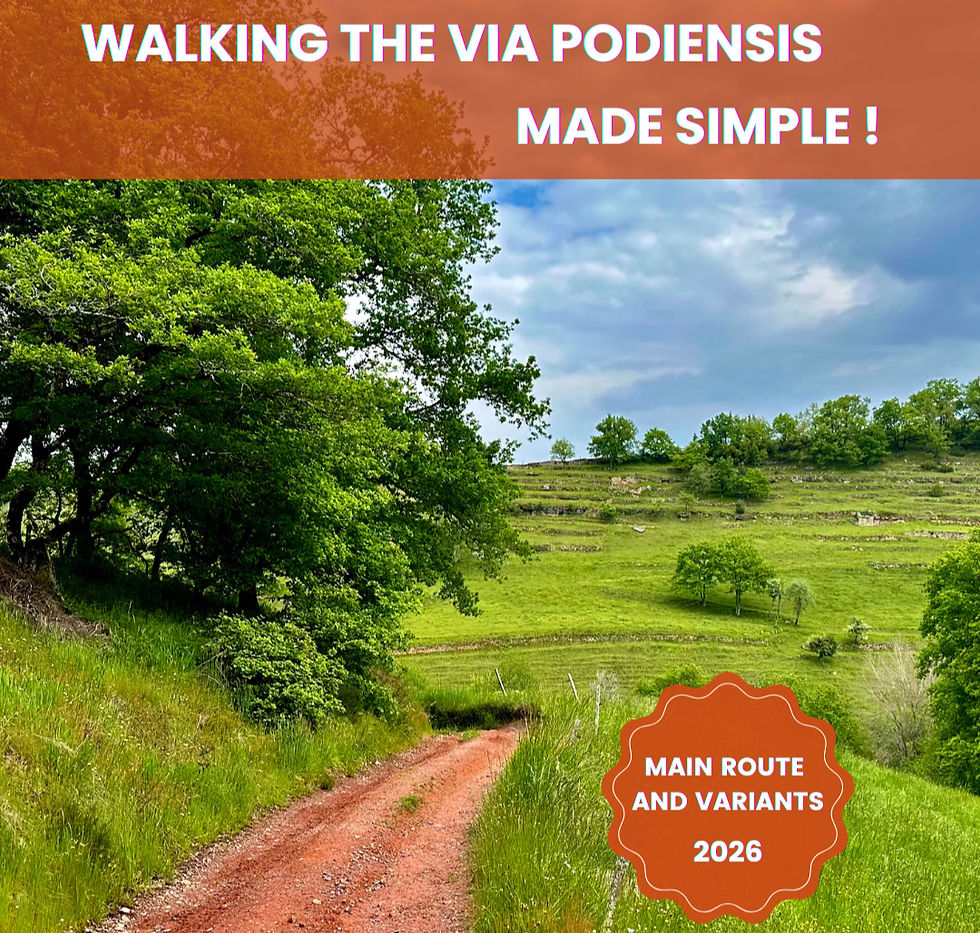
If you've used the guide to work out your stages and organise your trip, you've done exactly what it's there for.
But here's what I've learned:
Your itinerary should support your Camino, not run it.
If you've planned a 22-kilometre day and it takes you all day to walk it, that's fine.
If you arrive early and spend an hour sitting in a café, that's fine too.
If you stop for a long lunch because you've met someone interesting, you haven't somehow failed to stick to the plan.
Your booking tells you where you're sleeping.
It doesn't tell you what the day has to contain.
Planning gives you security.
It shouldn't take away your freedom.
Your body will teach you things your itinerary can't
You may have trained.
You may have walked increasingly long distances at home.
You may feel completely prepared.
And that's great.
But walking the Camino day after day is different.
You'll discover how your feet feel after five consecutive days.
You'll discover how much water you really need.
You'll discover whether you like a long lunch or would rather keep moving.
You'll discover that the hill you studied on an elevation profile feels rather different when you're standing at the bottom of it.
And, perhaps most importantly, you'll learn to recognise your own signals.
There is a difference between:
I'm tired, but I'm fine.
and:
I really need to stop.
Listen to the second one.
I've become much more interested in arriving at my gîte with enough energy left to enjoy the evening than in proving that I can push myself a little further.
The Camino is long.
You don't need to win the day.

The people you meet may change the shape of your day
This is one of the things I love most about the Camino.
You can leave your gîte in the morning knowing exactly where you're going and roughly when you'll arrive.
And then you meet someone.
Perhaps you walk together for twenty minutes.
Perhaps for three hours.
Perhaps you stop for coffee.
You discover you have something in common.
You keep walking.
Or perhaps you don't.
Perhaps you never see them again.
And yet that brief encounter becomes part of your Camino.
I've heard pilgrims worry that if they've booked all their accommodation, they won't experience the spontaneity people talk about on the Camino.
I don't think that's true.
You don't need an empty itinerary to be open to what happens.
You can stop and talk.
Sit in the shade.
Have another coffee.
Walk with someone for a while.
Take the time to look around you.
The spontaneous moments often happen in the spaces you haven't planned.

Not every day will be wonderful
This is something we don't always talk about when we describe the Camino.
There will probably be days when you're completely enchanted.
You'll walk through an extraordinary landscape. The weather will be perfect. Your body will feel strong. You'll have a wonderful conversation. You'll arrive somewhere beautiful and think:
This is exactly why I came.

And then there will be another day.
It might rain.
Your feet might hurt.
You might sleep badly.
Your gîte might not be what you expected.
You might be tired of walking.
You might not particularly like anyone you've met.
You might wonder why on earth you thought crossing France on foot was a good idea.
That's a Camino day too.
I've learned not to judge the whole experience by one difficult day.
Sometimes the best thing you can do is have a shower, eat something, get into bed and let tomorrow take care of itself.
Very often, tomorrow feels completely different.
You can't decide in advance what walking the Via Podiensis will be
People begin the Camino for all sorts of reasons.
Some want adventure.
Some want a challenge.
Some want time alone.
Some want to recover from something.
Some are looking for clarity.
Some are simply curious.
And some people couldn't really explain why they are doing it at all.
Whatever brings you to Le Puy, you may have an idea of what you hope to get from the experience.
But I'd be careful about holding onto that too tightly.
You might not find what you were looking for.
You might find something else.
I know this because my own Camino became something I could never have predicted.
When I first walked, I certainly didn't imagine that eleven years later I'd still be walking, talking and writing about it.
I didn't know I'd meet Rob on the Camino.
I didn't know the route would eventually become such a huge part of our lives.
I didn't know that the spreadsheet Rob created years ago would eventually become a guidebook.
I didn't know we'd build a community around the Via Podiensis.
I didn't know I'd create a French course for pilgrims.
And I certainly didn't know that one day we'd move to Pamplona.
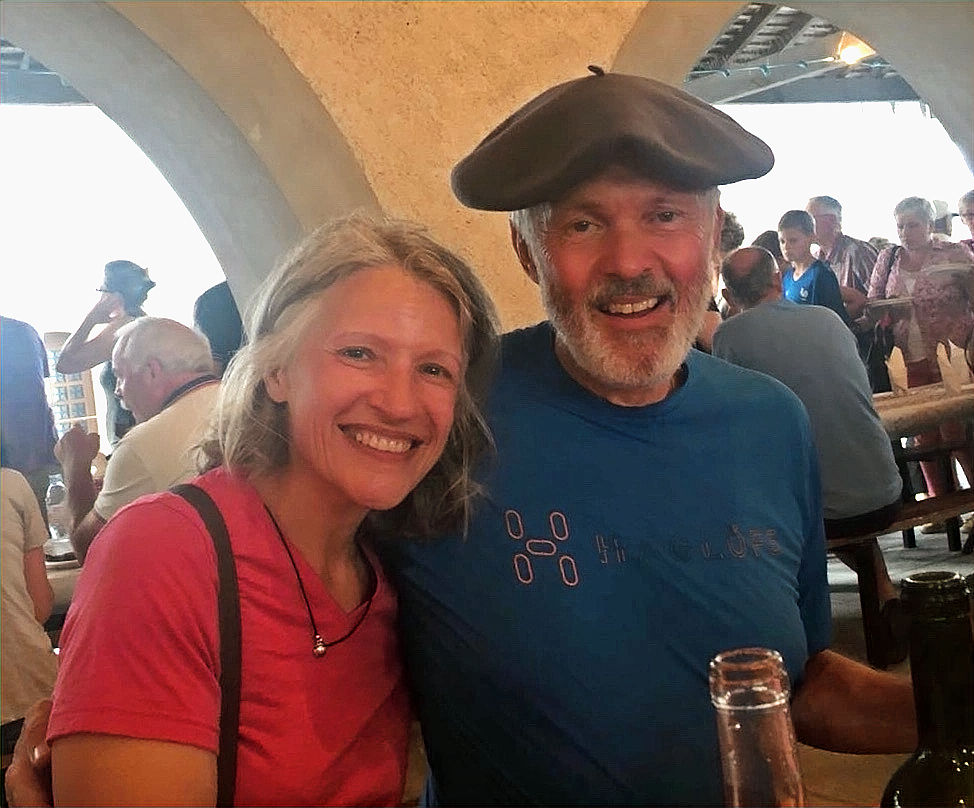
Looking back, I can see all these things as part of the same story.
But I couldn't have seen that story when I took my first steps.
That's one of the strange things about a journey.
You can know where you're going without knowing what it will mean.
And now I live in Pamplona!
This is the newest chapter — and one I certainly didn't see coming when I first walked the Camino.
For eleven years, the Camino was somewhere I travelled to.
Now I live in Pamplona.
And suddenly I'm seeing pilgrims from a different perspective.
I notice the backpacks.
I recognise the slightly uncertain look of someone who has just arrived.
I see people consulting maps and looking for signs.
And I find myself thinking:
I remember being you.

But I also know something they don't know yet.
They haven't seen what this journey is going to become in their lives.
They don't know which person they're going to meet.
They don't know which morning will stay in their memory.
They don't know which difficult day they'll laugh about years from now.
They don't know what they'll think about while walking across the Aubrac plateau, through the vineyards around Cahors or into the villages along the Lot.
They don't know yet whether they'll come home feeling exactly the same person who left.
I didn't know either.
And perhaps that's why, after eleven years, I still find the Camino difficult to explain.
I've walked enough of it to know the route.
But I've lived with it long enough to know that the route is only part of the story.
So, if you're about to begin...
If your gîtes are booked, your flights are organised and your backpack is waiting to be packed, I'd say this:
You've done enough planning.
If you've used Rob's guide to work out your stages, check the distances and elevation and get the practical details sorted, then you've done the part that can be planned.
Now comes the part that can't.
You don't need to know exactly what each day will bring.
You don't need to have the perfect Camino.
You don't need to make the most of every single minute.
And you don't need to come home with a life-changing revelation.
Just start.
Walk your first day.
Then walk the next one.
Pay attention.
Listen to your body.
Talk to people.
Stop when something makes you want to stop.
Let yourself have a bad day.
Let yourself have a wonderful one.
And don't be too disappointed when the Camino doesn't behave exactly as you imagined.
Because after eleven years, I know something I couldn't possibly have known before my first step:
You can plan where you're going.
You just can't know what the journey is going to become.
And perhaps that's why, all these years later, I'm still walking.
Buen Camino.
Kate
Kate Forrester has been walking and writing about the Camino for more than eleven years. Her first Camino changed the course of her life, and she has returned to the paths of France many times since.
Together with her husband Rob, she runs Camino Way of Life, helping pilgrims prepare for and experience the Via Podiensis — from the practicalities of planning a journey to the deeper, less easily explained things that happen along the way.
A former drama teacher, storyteller and lifelong lover of walking, Kate believes that the Camino is more than a route from one place to another.
It is a journey that continues to unfold in you long after your feet have stopped walking.


Comments