
The Journey Behind Rob's Guide for the Via Podiensis (GR 65)
- Camino Way of Life

- May 29
- 5 min read
"Dad! You've never used a guide in your life."
My youngest son James said that just before I set off on my first Via Podiensis in 2011.
He was absolutely right.
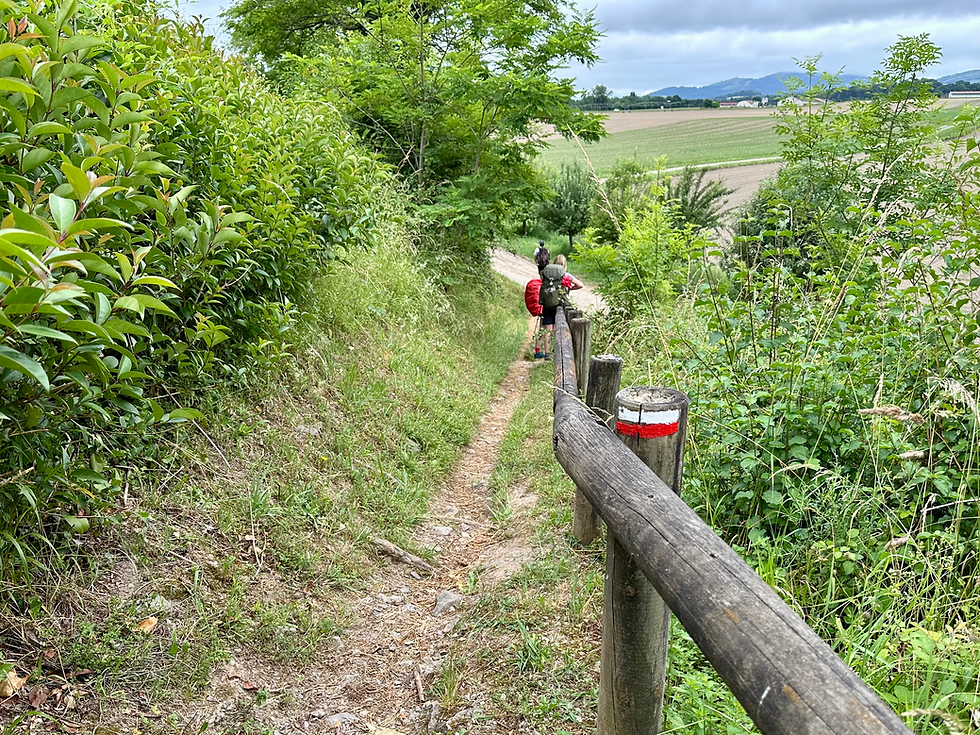
I had never used a guidebook before, and I had no intention of starting now. So I left the guidebooks behind and set off with little more than curiosity, a backpack, and the willingness to follow the white-and-red GR65 waymarks wherever they led.
At the time, I had no idea that decision would eventually lead to what thousands of pilgrims now know as Rob's Guide.

The Camino That Followed Me Home
Like many pilgrims, I returned home physically, but part of me remained on the Camino.
I was living in England then, helping care for my mother after a fall had left her largely confined to her home. Life had returned to its normal routines, yet I missed the friendships, conversations, and sense of freedom I had found on the Via Podiensis.
The problem was that I only had contact details for two people from the walk.
One of them, Artum from Moscow, suggested I try Facebook.
Until that moment, I had never used it.
Not only did I reconnect with Camino friends, but I also discovered an entire online community of pilgrims sharing stories, advice, photographs, encouragement, and dreams of future journeys.
One day I thought:
"Why not create a group dedicated to the Via Podiensis?"
At the time, there wasn't one.
So in October 2013, I started what would become the Camino Le Puy (GR65–Via Podiensis) Facebook group.
I had no business plan. No grand vision. No goals beyond creating a place where people who loved this remarkable route could find one another.
At first, it was little more than a handful of photos, a few memories, and some practical information I had collected along the way.
Then something unexpected happened.
Pilgrims began joining.
They asked questions. Shared experiences. Posted photographs. Offered advice.
Before long, people I had never met were helping other people I had never met.
Without anyone consciously trying to build one, a community emerged.
Looking back, that community became the heart of everything that followed.

A Single Sheet of Paper
Around the same time, I found myself inspired to create the first version of what would eventually become Rob's Guide.
The inspiration wasn't another guidebook.
It was a simple sheet of paper I had carried on the Camino Francés.
It was worn, coffee-stained, and anonymous. It contained little more than distances, accommodation listings, phone numbers, and practical notes.
Nothing fancy.
Yet it had given me everything I needed.
More importantly, it had preserved something I treasured about pilgrimage: surprise.
On my first Via Podiensis, I rarely knew what lay beyond the next hill, which village I would stop in, or who I might meet that day.
That uncertainty turned out to be one of the great gifts of the journey.
Every day held the possibility of discovery.
The little information sheet struck a balance that felt exactly right. It offered enough information to help, but not so much that it removed the adventure.
That became the philosophy behind Rob's Guide.
Not a guide designed to tell pilgrims what to experience.
A guide designed to help them discover the experience for themselves.
From One Page to Thousands of Pilgrims
The first version appeared in 2014.
It was a single sheet of paper printed on both sides, looking remarkably similar to the one that had inspired it.
Over the years it grew.
More villages.
More accommodation.
More practical information.
Better maps.
Better route data.
Yet the core idea never changed.
The guide was never intended to create a prescribed Camino.
It was intended to give pilgrims the confidence to create their own.

The Most Unexpected Camino Story
One of the most surprising chapters in this story began with a download.
In 2014, a woman living in Paris joined the Facebook group.
She downloaded Rob's Guide and used it while walking the Via Podiensis in 2015.
That September she began posting in the group.
To make a very long story short, we became friends.
Friendship became regular Eurostar journeys between France and England.
In 2017 we married, and Kate moved to the UK.
Even now it amazes me that a Facebook group and a simple Camino guide eventually introduced me to the person with whom I would share the rest of my life.
The Camino continues to surprise.

Continuing to Evolve
The guide has continued to evolve alongside the route itself.
Advances in mapping technology allowed me to create increasingly accurate route tracings, detailed maps, and elevation profiles. By 2025, the guide had grown into a far more comprehensive resource, including detailed maps, accommodation information, route variants, elevation profiles, and practical information for nearly every gîte along the Via Podiensis.
Yet even as it expanded, I remained mindful of the original goal: helping pilgrims travel with confidence while leaving room for discovery.
For the 2026 edition, I made another significant change.
Instead of organizing the guide around traditional stages, I organized it into sections of roughly 50 kilometres—typically two or three days of walking.
Why?
Because traditional stages often encourage pilgrims to follow someone else's itinerary.
Pilgrims walk at different speeds. They have different interests, different abilities, and different reasons for being on the Camino.
The route becomes richer when people are free to shape it according to their own journey.
That approach feels very much in keeping with the lesson I learned back in 2011: some of the best experiences happen when we leave space for the unexpected.

Looking Ahead
As I write this, Kate and I are preparing for a new chapter of our lives in Pamplona.
At the same time, work is already underway on the 2027 edition of Rob's Guide and on a new project: Walking the Camino Francés Made Simple.
When I think back to that first guide—a single sheet of paper shared among a small group of pilgrims—I am reminded how impossible it is to know where a path will eventually lead.
Twelve years ago, I had no idea how far that little guide would travel.
Or how many people it would help.
Or how profoundly it would change my own life.
And if there is one thing the Camino has taught me, it is this:
You do not always need to know what lies ahead.
Sometimes it is enough simply to take the next step.
Buen Camino,
Rob
If you'd like more information about the current guide: click here

I’m a long time pilgrim. I first walked le Puy to Santiago in 2011. The experience changed my life. I’ve walked many Caminos since. My experiences inspired me to live a Camino Way of Life.


Comments