
Why Walk the Le Puy Camino? 9 Reasons to Choose the Via Podiensis


There are many wonderful routes to Santiago de Compostela. So why choose the Le Puy Camino?
Perhaps you've heard about its beautiful landscapes, its medieval villages, or the wonderful food. Perhaps you're looking for a Camino that's a little quieter than the more popular routes through Spain.
Or perhaps you've never heard of it at all.
The Le Puy Camino, also known as the Via Podiensis, Chemin du Puy, Le Puy Route, or GR65, crosses some of the loveliest parts of rural France, from Le Puy-en-Velay to Saint-Jean-Pied-de-Port, at the foot of the Pyrenees.
It's a journey of roughly 750 kilometres, usually walked over four to six weeks, although there's absolutely no need to walk the whole thing at once.
We've walked this route ourselves, many times, and there are many reasons why we keep coming back to it.
Here are nine of them.
1. It has one of the most extraordinary starting points of any Camino! There are many wonderful places to begin a pilgrimage, but few can rival Le Puy-en-Velay.
The town itself is remarkable. Built among ancient volcanic formations, it's dominated by its magnificent cathedral and the extraordinary Chapel of Saint-Michel d'Aiguilhe, perched high on a volcanic pinnacle.
But it's what happens on the morning of your departure that makes Le Puy so special.
Every morning, pilgrims gather in the Cathedral of Notre-Dame du Puy for the traditional pilgrim Mass and blessing. Some have travelled halfway around the world to be there. Others have come from just down the road. Some are setting out on their very first Camino, while others are returning to a familiar path.
Backpacks rest against the pews. Walking poles are tucked away. There's a wonderful mixture of anticipation, excitement, and perhaps a little apprehension. And then comes a moment unlike any other.
After the pilgrim blessing, a grid in the cathedral floor is opened, allowing pilgrims to descend a broad stone staircase beneath the nave. They make their way down the steps, through the great doors, and out into the morning light, where the staircase continues towards the old town.
It's an extraordinary way to begin a pilgrimage.
You quite literally descend from the cathedral into the streets of Le Puy, and from there, onto the long road to Santiago.

And suddenly, all those months of dreaming and planning become something very real.
For Kate, that moment holds a particularly special memory.
I actually missed this wonderful departure the first time I walked from Le Puy. I was in such a hurry to be on the Way that I left just after the pilgrim blessing, completely unaware of what I was missing.But that was all part of my first Camino... and I'll tell you more about that another time. The second time, with Robert, I made sure I was there! And as we descended those cathedral steps with the other pilgrims, I found myself crying. I hadn't expected it. There was something about that moment, the people around us, the beauty of the setting, and the knowledge that we were all beginning a journey together. It's a memory that has stayed with me ever since. — Kate
You're no longer preparing to walk the Camino.
You're walking it.
Of course, the first few days will soon remind you that this is no gentle stroll!
The climbs and descents between Le Puy and Saugues can be demanding, particularly when you're still finding your walking rhythm.
But there's no need to rush. You can break those first stages into shorter days, enjoy the spectacular countryside, and give yourself time to settle into the journey.
What a wonderful way to begin a pilgrimage!
2. The landscapes never stop changing
One of the great pleasures of the Le Puy Camino is the extraordinary variety of landscapes.
You begin among the volcanic hills of the Velay, cross the wild open spaces of the Aubrac plateau, descend into the beautiful Lot Valley, and eventually find yourself walking through the rolling countryside of Gascony and the green foothills of the Basque Country.
Some days, the views seem to stretch forever.
On the Aubrac, the landscape opens into vast stretches of grassland, punctuated by dry-stone walls and the occasional buron, a traditional stone building once used by herders and cheesemakers.
There's something particularly wonderful about the Aubrac. The immense skies, the open horizons, the sense of space. It's a landscape that seems to invite you to breathe a little more deeply and simply enjoy being there.

Other days, you're walking through woodland, alongside rivers, or between old stone walls.
And then, quite unexpectedly, the landscape changes again.
The beauty of this route isn't simply that the scenery is spectacular. It's that you experience those changes gradually, on foot, one day after another.
3. You'll discover some of France's most beautiful villages
France has an official designation, Les Plus Beaux Villages de France, awarded to villages of exceptional heritage and beauty.
The Le Puy Camino passes through several of them.
There's Saint-Côme-d'Olt, with its unusual twisted church spire. Estaing, with its castle and beautiful old bridge. And then there's Conques.
Conques deserves time.
Its narrow medieval streets, stone houses, and magnificent Abbey Church of Sainte-Foy make it one of the most memorable places on the route.

But it's not just the famous villages that stay with you.
Sometimes it's a tiny hamlet, a church you weren't expecting, or a quiet square where you stop for a coffee.
Perhaps there's a fountain where you refill your water bottle, an elderly resident sitting outside a house, or a little bakery you hadn't expected to find.
These are places worth lingering in.
And one of the pleasures of walking rather than travelling by car is that you arrive slowly enough to notice them.
4. Food is part of the adventure
Walking across France means discovering its regional food, one meal at a time.
Lentils from Le Puy, cheeses from the Aubrac, aligot, local sausages, walnuts, wines from Cahors, Armagnac, and the wonderful food of the Basque Country.
Food changes as you travel, reflecting the landscape, agriculture, and traditions of each region.
And after a long day of walking, even the simplest meal can taste extraordinary.
But there's another pleasure that has little to do with what's on your plate.
In many traditional pilgrim gîtes, everyone gathers around a communal table for dinner.
You may find yourself sharing a meal with people from several different countries, passing around dishes, exchanging stories, and discovering that you have much more in common than you imagined.

Some of our happiest Camino memories have been made around a dinner table.
And sometimes the conversation continues long after the plates have been cleared.
5. There's a wonderful sense of history
The Le Puy Camino is part of a pilgrimage tradition stretching back more than a thousand years.
In 950, Godescalc, Bishop of Le Puy, made a pilgrimage to Santiago de Compostela. We don't know precisely which route he followed, but his journey became part of the history associated with Le Puy.
Today, you walk past Romanesque churches, medieval bridges, ancient abbeys, and villages that have welcomed travellers for centuries.
Some of the buildings you'll encounter are extraordinary.
The Abbey Church of Sainte-Foy in Conques, with its remarkable Romanesque sculpture, is one example. The abbey church at Moissac, famous for its magnificent cloister and sculpted portal, is another.
But history isn't confined to the great monuments.
It's there in the old stone crosses beside the path, the little chapels, the worn steps, and the ancient bridges that have carried generations of travellers across rivers.
You don't have to be religious to appreciate any of this.
There's something moving about entering an old church, sitting quietly for a few moments, and thinking about all the people who have passed through before you.
6. You'll experience a different side of France
This is one of the things we particularly love about the route.
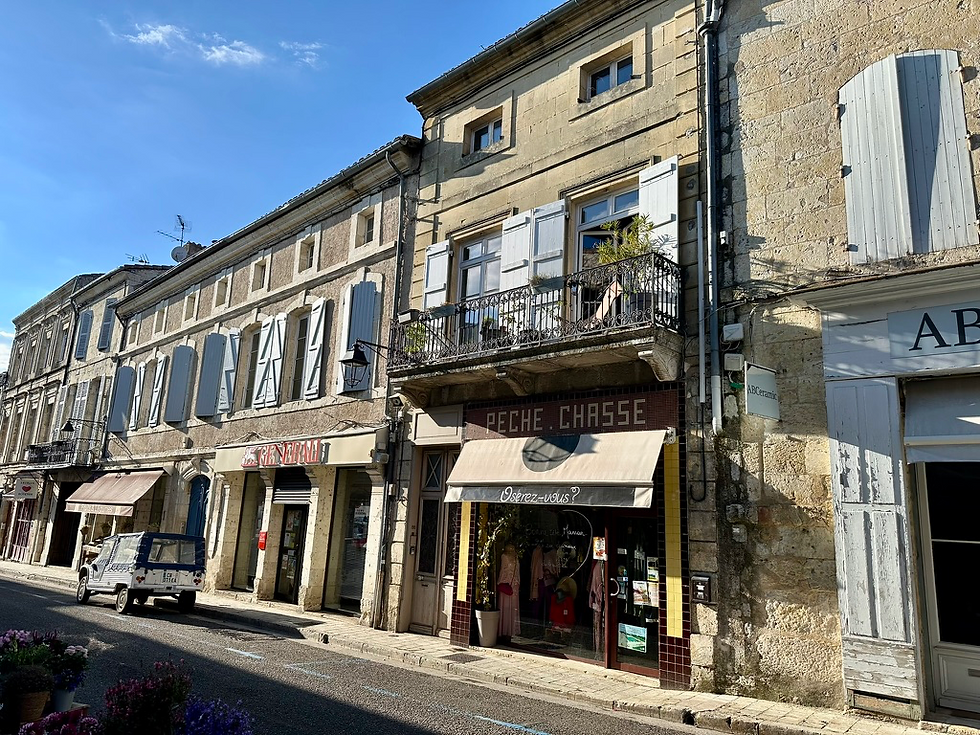
Much of the Le Puy Camino passes through rural France, far from the major tourist destinations.
You'll walk through farming communities, small market towns, and villages where everyday life continues around you.
You might stop at a bakery, chat with a shopkeeper, or exchange a few words with someone working in their garden.
You'll encounter local customs, regional dishes, and different accents as you move across the country.
And yes, a little French helps!
But you don't need to speak fluent French to enjoy the experience.
A few useful expressions, a willingness to communicate, and a sense of humour can go a long way.
Learning to say Bonjour, Merci, or Est-ce qu'il vous reste une place pour ce soir ? (Do you still have a bed available for tonight?) can make everyday encounters easier and more enjoyable.
The Camino offers a wonderful opportunity to discover France beyond its famous cities.
And perhaps to discover how rewarding it can be to communicate, even when you don't have all the words.
7. There's companionship, but also room for solitude
One of the pleasures of walking the Le Puy Camino is the balance between company and quiet.
You can spend hours walking alone, enjoying the landscape and your own thoughts.
Then, in the evening, you may find yourself sitting around a table with people you've met along the way.
The traditional pilgrim gîtes are an important part of this experience.
They aren't simply places to sleep.
At their best, they're places where friendships begin, stories are shared, and strangers become companions. You may walk with someone for a day or two, lose touch for a while, and then unexpectedly meet again several stages later. These little reunions are part of the pleasure of a long-distance Camino.
Of course, there are also chambres d'hôtes, small hotels, and other accommodation options if you prefer more privacy. There's room for different ways of walking. And while the Le Puy Camino has become increasingly popular, it can still offer long stretches of peaceful walking, particularly away from the busiest periods.
8. You don't have to walk the whole route
Not everyone has five or six weeks available for a pilgrimage.
And that's perfectly fine.
The Le Puy Camino lends itself beautifully to walking in sections.
You could spend a week walking from Le Puy towards the Aubrac, take a couple of weeks to reach Conques, or explore the beautiful countryside around Figeac and Cahors.
You can return another year and continue where you left off.
Some people walk the route in several separate journeys, returning whenever time and circumstances allow.
Others choose a particular section simply because it appeals to them.
There's no rule that says a Camino has to be completed in one journey.
And there's certainly no reason to think that walking a shorter section makes the experience any less meaningful.
Sometimes walking a small part of a long route is enough to make you want to come back.
9. It gives you the chance to slow down
Perhaps this is the most important reason of all.
When you're walking day after day, something begins to change.
You become more aware of the weather, the landscape, the people you meet, and the small pleasures of everyday life.
A good cup of coffee. A shady place to sit. A beautiful view. A conversation you weren't expecting.
You begin to appreciate things that are easily overlooked in ordinary life.
There's something wonderfully liberating about having so little to do each day, and yet finding that the days are so full.
You get up, put on your boots, shoulder your backpack, and walk.
Of course, there are practical things to think about. Where will you sleep tonight? Is there somewhere to buy food? How far is the next village?
But gradually, you may find yourself becoming less concerned with controlling every detail of the journey.
And while there's nothing wrong with planning, some of the loveliest Camino experiences are the ones you couldn't possibly have planned.
A little planning can make the journey easier, but don't let your plans dictate your Camino.
Once you're on the Way, let the days unfold.
Leave room for the unexpected.
You might be surprised by what you discover.
Ready to Walk the Le Puy Camino?
Whether you're planning to walk the entire Via Podiensis or just a section, we've put together practical resources to help you prepare.
On Camino Way of Life, you'll find articles about choosing your stages, finding accommodation, navigating the route, and preparing for the challenges of walking across France.
We've also created two resources especially for pilgrims planning this journey.
Walking the Via Podiensis Made Simple is our comprehensive downloadable PDF guide to the Le Puy Camino, with maps, accommodation information, route details, and practical advice to help you plan and walk with confidence.
And if you're worried about managing in France without speaking the language, our French for the Camino video course teaches you the everyday French you'll actually need along the Way.
But whatever resources you use to prepare, remember that the Camino is about much more than getting from one place to another.
It's about everything that happens along the way.
Have you walked the Le Puy Camino? What made it special for you? Or, if you're still planning your journey, what attracts you most to this beautiful route?
We'd love to hear from you.
Kate & Robert Forrester

We're the creators of Camino Way of Life. Having walked the Via Podiensis ourselves, multiple times, we share practical advice, resources, and stories to help others discover and enjoy this remarkable pilgrimage route.


Comments